

Haiti, officially the Republic of Haiti,is a country on the island of Hispaniola in the Caribbean Sea, east of Cuba and Jamaica, and south of The Bahamas. It occupies the western three-eighths of the island, which it shares with the Dominican Republic. Haiti is the third largest country in the Caribbean, and with an estimated population of 11.4 million, is the most populous Caribbean country. The capital and largest city is Port-au-Prince.


Haiti, whose population is almost entirely descended from enslaved African people, won independence from France in 1804, making it the second country in the Americas, after the United States, to free itself from colonial rule. Over the centuries, however, economic, political, and social difficulties as well as a number of natural disasters have beset Haiti with chronic poverty and other serious problems.
Haiti is a founding member of the United Nations, Organization of American States (OAS), Association of Caribbean States, and the Organisation internationale de la Francophonie. In addition to CARICOM, it is a member of the International Monetary Fund, World Trade Organization, and Community of Latin American and Caribbean States. Historically poor and politically unstable, Haiti has the lowest Human Development Index in the Americas.

The flag of Haiti (drapo Ayiti) is a bicolour featuring two horizontal bands coloured blue and red, emblazoned by a white rectangular panel bearing the coat of arms of Haiti. The coat of arms depicts a trophy of weapons atop a green hill and a royal palm symbolizing independence. The palm is topped by the Cap of Liberty. The motto L’Union fait la Force (‘Unity makes strength‘) appears on a white ribbon below the arrangement.


Haiti’s entire history has been beset with horrific natural disasters from hurricanes to catastrophic earthquakes. They have had non-stop corrupt government leaders. The nation’s life has been sad upon sad.
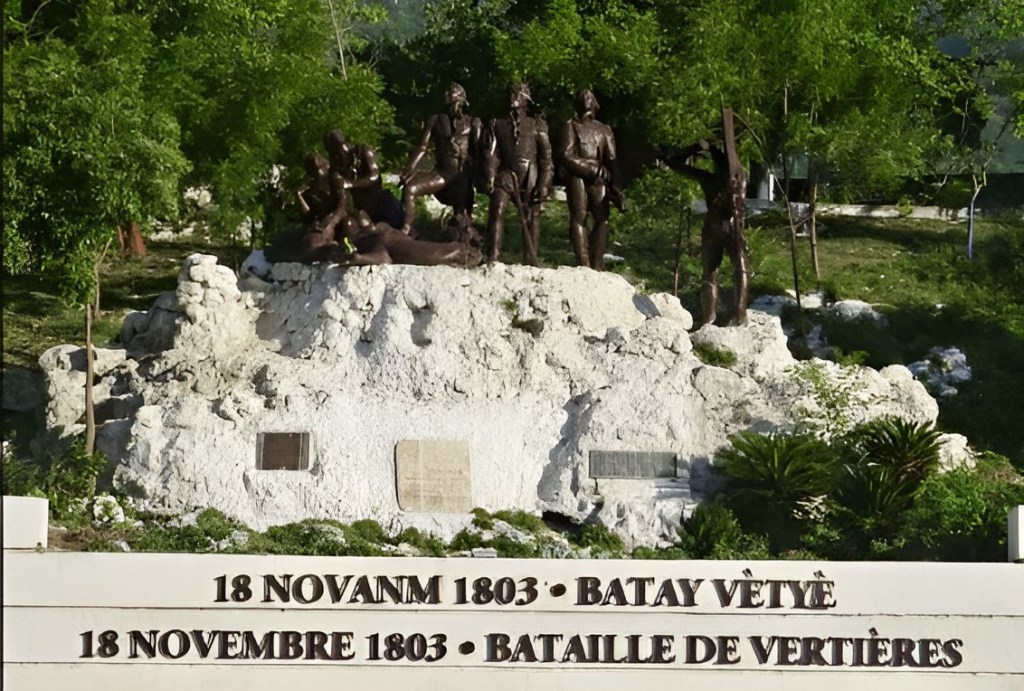
The Battle of Vertières(French: Bataille de Vertières; Haitian Creole: Batay Vètyè) was the last major battle of the Saint-Domingue expeditionand the final phase of the Haitian Revolution. It was fought on 18 November 1803 between the rebel Indigenous Army under Jean Jacques Dessalines and François Capois and French forces under Donatien de Rochambeau, who were committed to regaining control of the island. The Haitians were fearful that if the French took over Haiti again, they, the French, would restore slavery. November 18 has been widely celebrated since 1803 as a Day of Victory in Haiti.





Leave a Reply