
The Irish Travelers
Irish Travellers (Irish: An lucht siúil, meaning the walking people), also known as Mincéirs (Shelta: Mincéirí) or Pavees, are a traditionally peripatetic indigenous ethno-cultural group originating in Ireland.

“Despite sometimes being incorrectly referred to as “Gypsies“, Irish Travellers are not genetically related to the Romani people, who are of Indo-Aryan origin. Genetic analysis has shown Irish Travellers to be of Irish descent, and that they likely diverged from the settled Irish population in the 1600s, probably during the time of the Cromwellian conquest of Ireland.”
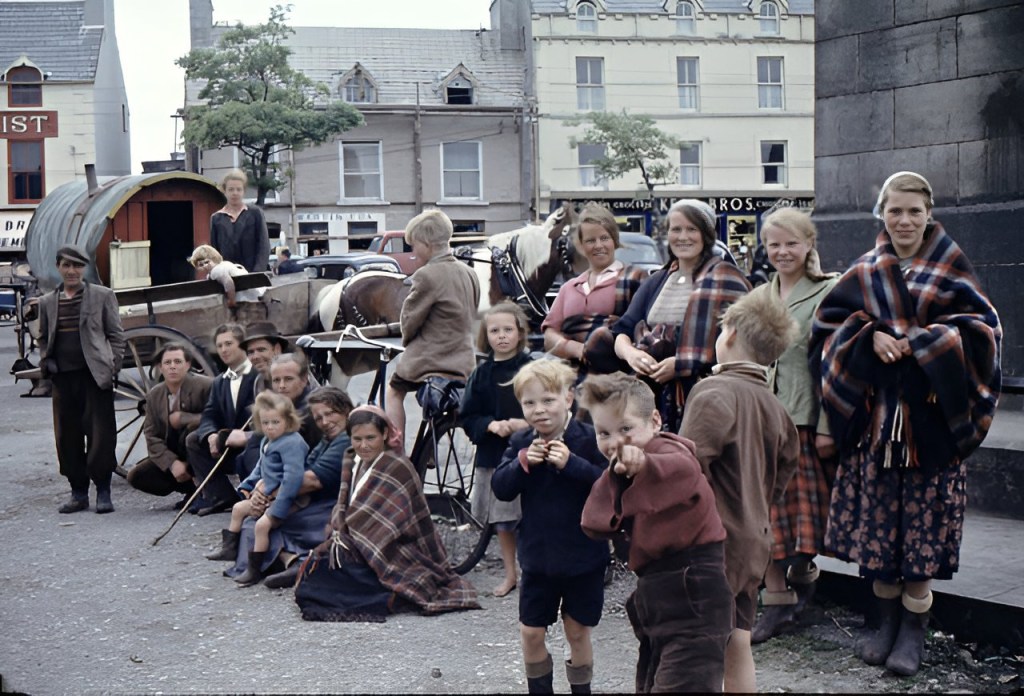
Travellers near the Four Masters monument in Donegal Town, 1958
“Irish Traveller communities are located in Ireland, the United Kingdom, the United States and Canada. In 2016, there were 32,302 Travellers within Ireland. In 2016, they were 0.7% of Ireland’s population. There are different estimates about the size of the total population of people with Traveller ancestry, because many people of Traveller descent do not declare themselves Travellers. The United Kingdom is believed to be home to up to 300,000 Roma and Traveller people, including Romanichal. The British Government considers Travellers resident in the UK to form part of the Gypsy, Roma and Traveller (GRT) community.”

“Irish Travellers speak English as well as their own language, known variously as Cant, Gammon, or Shelta. Cant is influenced by Irish and Hiberno-English and remains a largely unwritten language. Historically associated with rural Ireland, Travellers today live mainly in cities, the majority living in Dublin and the surrounding suburbs, followed by Galway and Cork.”
“Travellers are often reported as the subject of explicit political and cultural discrimination, with politicians being elected on promises to block Traveller housing in local communities and individuals frequently refusing service in pubs, shops and hotels. Settled populations often misinterpret Travellers’ cultural differences, which results in their marginalization across different sectors of society.”

The fact that there are still groups of nomads in existence in various countries, even first world locations, is very interesting.
This group of people, especially in Ireland, has asked the government to recognize that they do exist and since they exist, could they be heard and represented in society and in government. Much like the civil rights movements in the USA and other countries, The Irish Travelers Movement is beginning to organize.

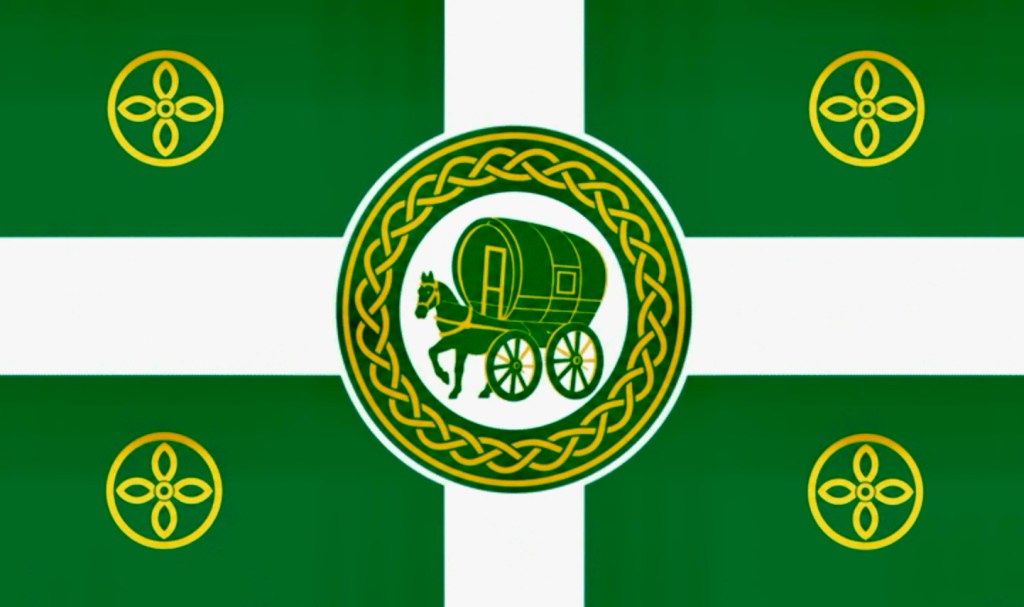
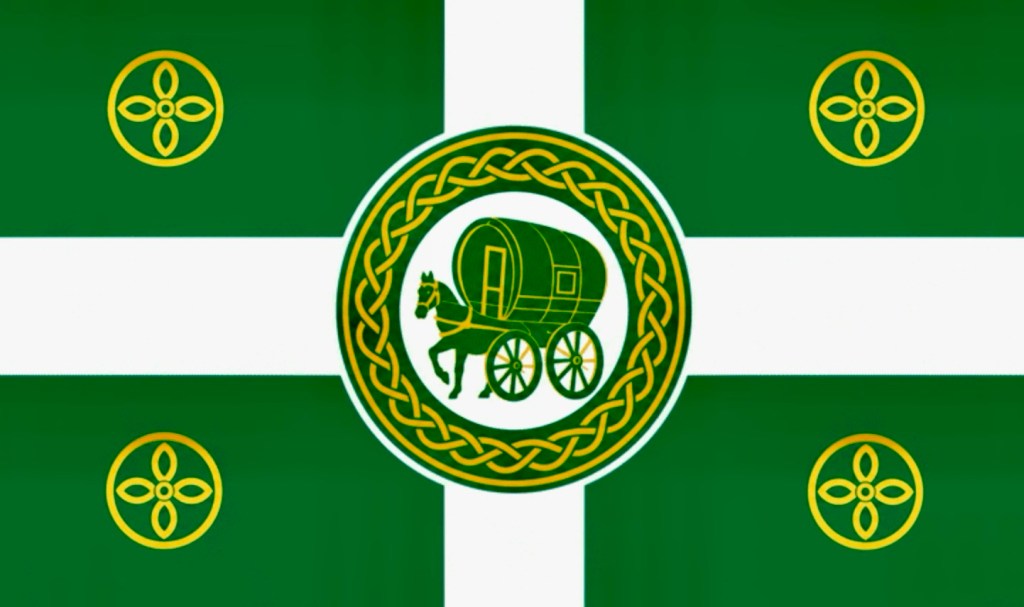
Once organized the Irish Traveller Movement realized there are other groups of nomads in Ireland. Now the movement includes: Irish Travelers; Gypsies and The Roma people. Now with this inclusive group a new flag was designed.

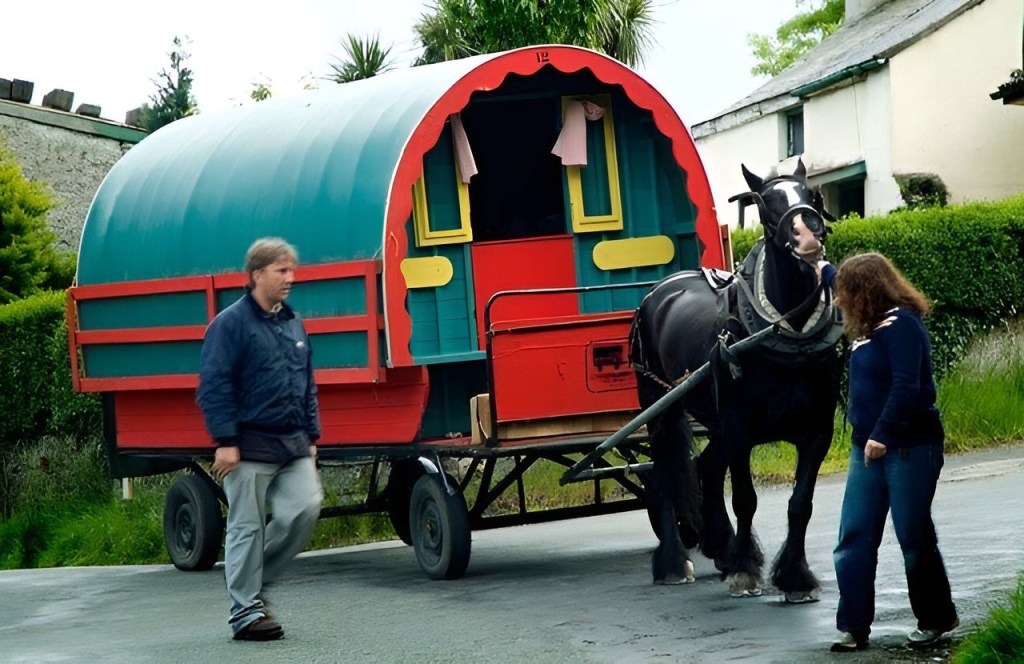
The flag is a white cross (a vast majority of the Irish Travelers are Roman Catholics) on a green field (green for Ireland.) In each of the four corners are a gold shamrock for the four provinces. In the middle of the white cross is a barrel shaped wagon (for the history, travel traditionally was with a horse drawn wagon) surrounded by a circle with a Golden Celtic knot (standing for eternity and interconnectedness.)


A creative, interesting flag representing not a place, but a people.



Leave a Reply