

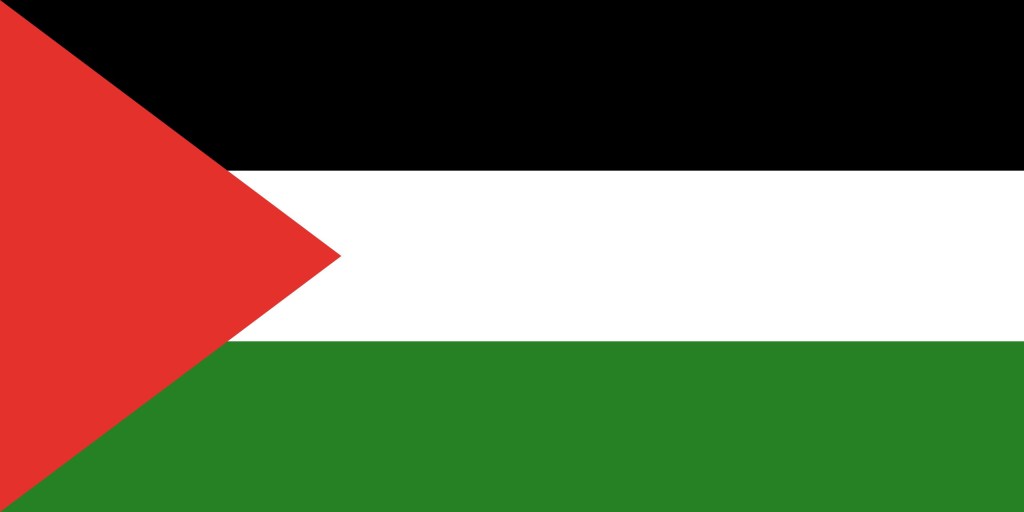
The Flag of Palestine. A tricolor of three equal horizontal stripes (black, white, and green from top to bottom) overlaid by a red triangle issuing from the hoist. This flag is derived from the Pan-Arab colors and is used to represent the State of Palestine and the Palestinian people. It was first adopted on 28 May 1964 by the Palestinian Liberation Organization.
I find it sad that this is considered a controversial flag to fly. I understand this part of the world has been in conflict for hundreds of years. When I think of how people have been treated by the USA ally that for many years we felt could do no wrong I know ‘it ain’t right’.

People are people. Mistreated is mistreated.
Two, one-two-three-four!

Ev'rybody's talking 'bout
Bagism, Shagism, Dragism, Madism, Ragism, Tagism
This-ism, that-ism, is-m, is-m, is-m

All we are saying is give peace a chance
All we are saying is give peace a chance

Hit it
C'mon, ev'rybody's talking about
Ministers, sinisters, banisters and canisters
Bishops and Fishops and Rabbis and Popeyes and bye-bye, bye-byes

All we are saying is give peace a chance
All we are saying is give peace a chance

Let me tell you now
Ev'rybody's talking 'bout
Revolution, evolution, masturbation, flagellation, regulation, integrations
Meditations, United Nations, congratulations

All we are saying is give peace a chance
All we are saying is give peace a chance

Ev'rybody's talking 'bout
John and Yoko, Timmy Leary, Rosemary, Tommy Smothers, Bobby Dylan, Tommy Cooper
Derek Taylor, Norman Mailer, Alan Ginsberg, Hare Krishna, Hare, Hare Krishna

All we are saying is give peace a chance
All we are saying is give peace a chance

All we are saying is give peace a chance
All we are saying is give peace a chance
Bonus material:
Suffering in the Holy Land
Palestinian Christian pastor Dr. Munther Isaac reflects on what it means for his family and faith to endure injustice:
“Daddy, why did they stop us yet allow the other car to pass?”
This was the question my seven-year-old son asked me when the Israeli soldiers sent us back at the checkpoint on our way to Jerusalem, having realized that the special permits we obtained from the Israeli military to cross to Jerusalem had expired.
Try explaining the segregation system we have here to a seven-year-old boy! How do I tell him that we need a permit to cross to Jerusalem while Israeli settlers don’t? Or that my ID card as a resident of the West Bank (that I must carry with me all the time) is different than that of Jerusalemite Palestinians, or Palestinians who hold an Israeli citizenship, or a Gazan (the worst of all IDs)? How do I explain to him this system of segregation that exists in the land today?
I am forty years old, and I have already witnessed so many wars and uprisings that I would need a whole book to write about them. Walls, settlements, and checkpoints are our daily experience. Conflicts and divisions define our reality. How do I understand God, let alone teach the Bible, in such a context?
A theology from behind the wall is concerned with day-to-day issues in Palestine. We are preoccupied with issues of life under occupation, injustice, nonviolence, religious extremism, and peacemaking. We talk about identity and nationality. We do not write theology in libraries; we write it at the checkpoint. We bring Christ in dialogue with the checkpoint. We simply ask, What would Jesus say or do if he were to stand in front of the wall today? What would he say or do if he were to stand at a checkpoint today for five or six meaningless hours? What would his message be to the Palestinian trying to cross it and to the Israeli soldiers stopping them?
Isaac wonders what it will take for the Holy Land to become a just and peaceful home for Jews, Muslims, and Christians:
My ancestors have been living in this land for hundreds of years. For me and my family, the Holy Land is “home.” We belong to this land, and we have been part of its story. The reality I grew up in is one of conflict and oppression. My family has lost land, and I have seen loved ones emigrate from the land and witnessed others forced to leave.…
Palestine today is fractured by settlements, walls, and checkpoints. It is also plagued by religious extremism and violence. Will this land I call “home” become a place where God can be experienced? Can it become a place where the justice and peace of God reign? Can it become a place where Jews, Muslims, and Christians share the land and its resources, have the same rights, and embrace each other as fellow human beings and be reconciled with one another?

 deliriouslove1970. The life & times of Gary and Denise Flanders. (Free and worth every penny. If you would like to compliment the editor, send to garytheflan@deliriouslove1970.com. If you would like to complain, call your mother.)
Leave a comment