

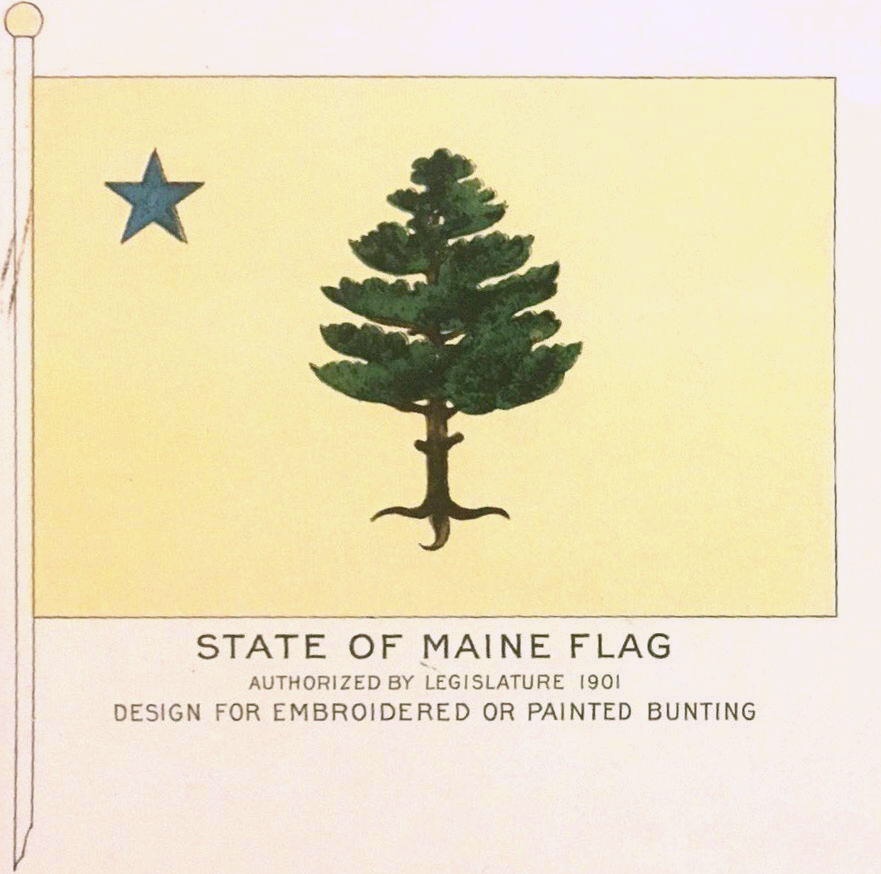
A truly beautiful flag, the erstwhile (thank you Dictionary.com word of the day) flag of the state of Maine. This was the official Maine Flag from 1901 to 1909. Then, as is true of so many things, politicians got involved and adopted a truly ugly flag.
The flag from 1909 to present has been recognized by the North American Vexillological Association (NAVA) as the worst flag of any state in the Union. It breaks all of the rules and is a case study of a ‘bad flag’ in the NAVA publication, ‘Good Flag, Bad Flag’
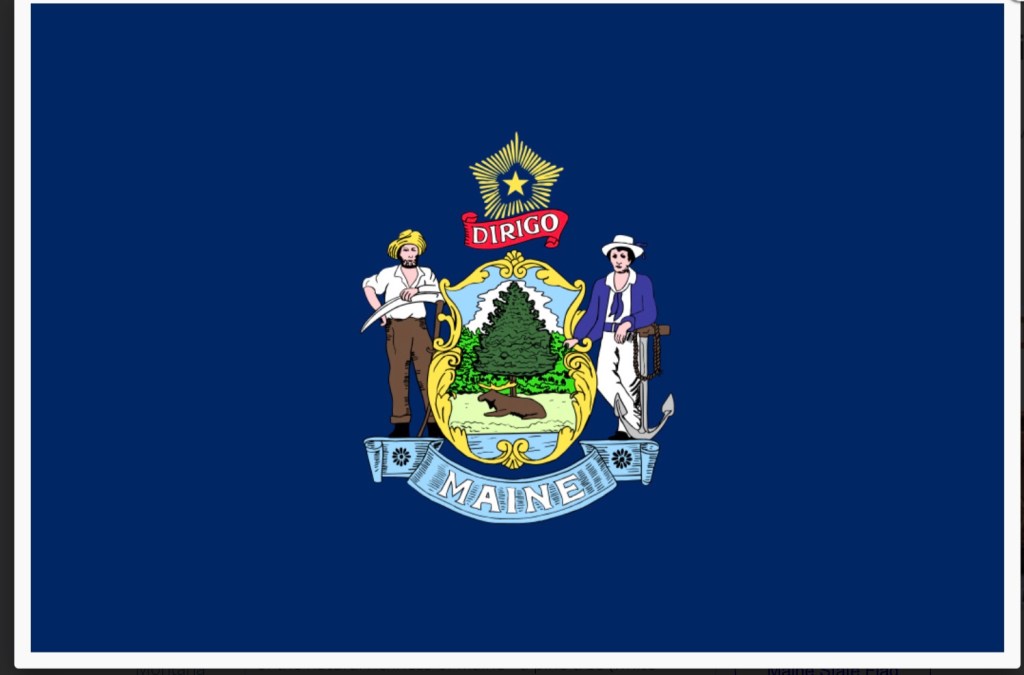
The current flag is a boring blue field with the Maine seal in the center. Almost half of the states have the same ugly flag with the only difference being it is their seal. Therefore, none of them are distinguishable and all of them are…ugly. (That word, ‘Dirigo’ refers to the Northern Star.)
Here is a photo the original beautiful flag.
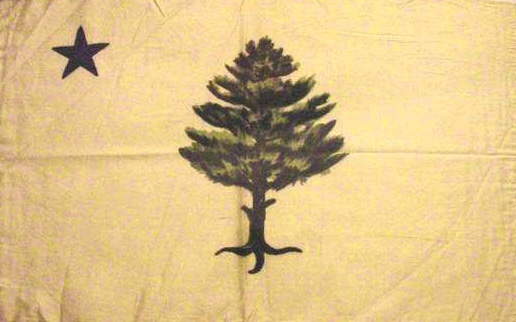
It is a ‘buff’ field (originally a tanned deer hide) with the symbol of New England – a pine tree. In the upper corner is The Northern Star (should have left it at that instead of using the word ‘Dirigo’).
This flag has creative style. You immediately know it is Maine. It does not need words. This flag would immediately be recognized as one of the best flags in the United States.
In a statewide ballot in November 2024, the people voted not to change back to the Pine Tree flag.
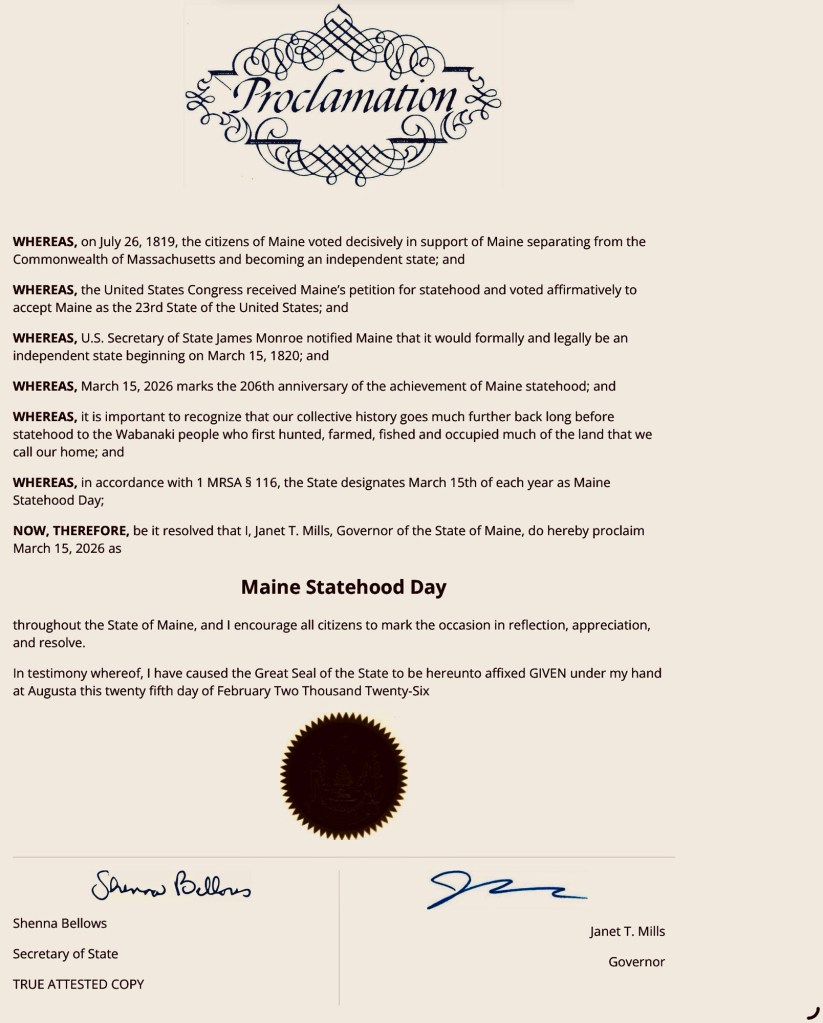
Today, March 15, marks the day Maine was admitted to The US in 1819 as the 23rd state.
Addendum: Some interesting factoids about Maine’s history from Heather Cox Richardson.
“March 15 is a crucially important day in U.S. history. As the man who taught me to use a chainsaw said, it is immortalized by Shakespeare’s famous warning: “Cedar! Beware the adze of March!”
He put it that way because the importance of March 15 is, of course, that it is the day in 1820 that Maine, the Pine Tree State, joined the Union.
Maine statehood had national repercussions. The inhabitants of this northern part of Massachusetts had asked for statehood in 1819, but their petition was stopped dead by southerners who refused to permit a free state—one that did not permit human enslavement—to enter the Union without a corresponding “slave state.” The explosive growth of the northern states had already given free states control of the House of Representatives, but the South held its own in the Senate, where each state got two votes. The admission of Maine would give the North the advantage, and southerners insisted that Maine’s admission be balanced with the admission of a southern slave state lest those opposed to slavery use their power in the federal government to restrict enslavement in the South.
They demanded the admission of Missouri to counteract Maine’s two “free” Senate votes.
But this “Missouri Compromise” infuriated northerners, especially those who lived in Maine. They swamped Congress with petitions against admitting Missouri as a slave state, resenting that slave owners in the Senate could hold the state of Maine hostage until they got their way. Tempers rose high enough that Thomas Jefferson wrote to Massachusetts—and later Maine—senator John Holmes that he had for a long time been content with the direction of the country, but that the Missouri question “like a fire bell in the night, awakened and filled me with terror. I considered it at once as the knell of the Union. It is hushed indeed for the moment, but this is a reprieve only, not a final sentence.”
Congress passed the Missouri Compromise, but Jefferson was right to see it as nothing more than a reprieve.
The petition drive that had begun as an effort to keep the admission of Maine from being tied to the admission of Missouri continued as a movement to get Congress to whittle away at slavery where it could—by, for example, outlawing the sales of enslaved Americans in the nation’s capital—and would become a key point of friction between the North and the South.
There was also another powerful way in which the conditions of the state’s entry into the Union would affect American history. Mainers were angry that their statehood had been tied to the demands of far distant slave owners, and that anger worked its way into the state’s popular culture. The opening of the Erie Canal in 1825 meant that Maine men, who grew up steeped in that anger, could spread west.
And so they did.
In 1837, Elijah P. Lovejoy, who had moved to Alton, Illinois, from Albion, Maine, to begin a newspaper dedicated to the abolition of human enslavement, was murdered by a pro-slavery mob, who threw his printing press into the Mississippi River.
Elijah Lovejoy’s younger brother, Owen, had also moved west from Maine. Owen saw Elijah shot and swore his allegiance to the cause of abolition. “I shall never forsake the cause that has been sprinkled with my brother’s blood,” he declared. He turned to politics, and in 1854 he was elected to the Illinois state legislature. His increasing prominence brought him political friends, including an up-and-coming lawyer who had arrived in Illinois from Kentucky by way of Indiana, Abraham Lincoln.
Lovejoy and Lincoln were also friends with another Maine man gone to Illinois. Elihu Washburne had been born in Livermore, Maine, in 1816, when Maine was still part of Massachusetts. He was one of seven brothers, and one by one, his brothers had all left home, most of them to move west. Israel Washburn Jr., the oldest, stayed in Maine, but Cadwallader moved to Wisconsin, and William Drew would follow, going to Minnesota. (Elihu was the only brother who spelled his last name with an e).
Israel and Elihu were both serving in Congress in 1854 when Congress passed the Kansas-Nebraska Act, overturning the Missouri Compromise and permitting the spread of slavery to the West. Furious, Israel called a meeting of 30 congressmen in May to figure out how they could come together to stand against the Slave Power that had commandeered the government to spread the South’s system of human enslavement. They met in the rooms of Representative Edward Dickinson, of Massachusetts—whose talented daughter Emily was already writing poems—and while they came to the meeting from all different political parties, they left with one sole principle: to stop the Slave Power that was turning the government into an oligarchy.
The men scattered for the summer back to their homes across the North, sharing their conviction that a new party must rise to stand against the Slave Power. In the fall, those calling themselves “anti-Nebraska” candidates were sweeping into office—Cadwallader Washburn would be elected from Wisconsin in 1854 and Owen Lovejoy from Illinois in 1856—and they would, indeed, create a new political party: the Republicans. The new party took deep root in Maine, flipping the state from Democratic to Republican in 1856, the first time it fielded a presidential candidate.
In 1859, Abraham Lincoln would articulate an ideology for the party, defining it as the party of ordinary Americans standing together against the oligarchs of slavery, and when he ran for president in 1860, he knew it was imperative that he get the momentum of Maine men on his side. In those days Maine voted for state and local offices in September, rather than November, so a party’s win in Maine could start a wave. “As Maine goes, so goes the nation,” the saying went.
So Lincoln turned for his vice president to Hannibal Hamlin, who represented Maine in the Senate (and whose father had built the house in which the Washburns grew up). Lincoln won 62% of the vote in Maine in 1860, taking all eight of the state’s electoral votes, and went on to win the election. When he arrived in Washington quietly in late February to take office the following March, Elihu Washburne was at the railroad station to greet him.
I was not a great student in college. I liked learning, but not on someone else’s timetable. It was this story that woke me up and made me a scholar. I found it fascinating that a group of ordinary people from country towns who shared a fear that they were losing their democracy could figure out how to work together to reclaim it.
Happy Birthday, Maine.
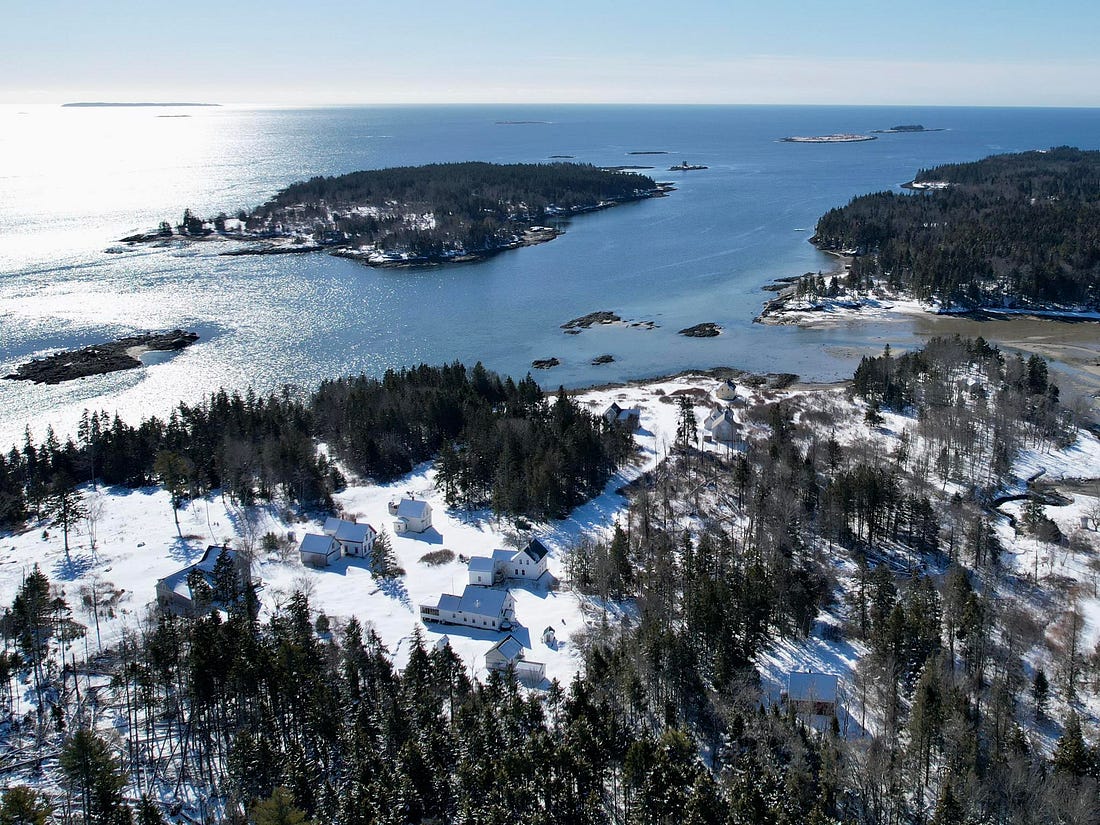
[Photo of a Maine Island community after a snowstorm by Buddy Poland]
From ‘Letters from an American’ March 14 2026.

 deliriouslove1970. The life & times of Gary and Denise Flanders. (Free and worth every penny. If you would like to compliment the editor, send to garytheflan@deliriouslove1970.com. If you would like to complain, call your mother.)
Leave a comment