
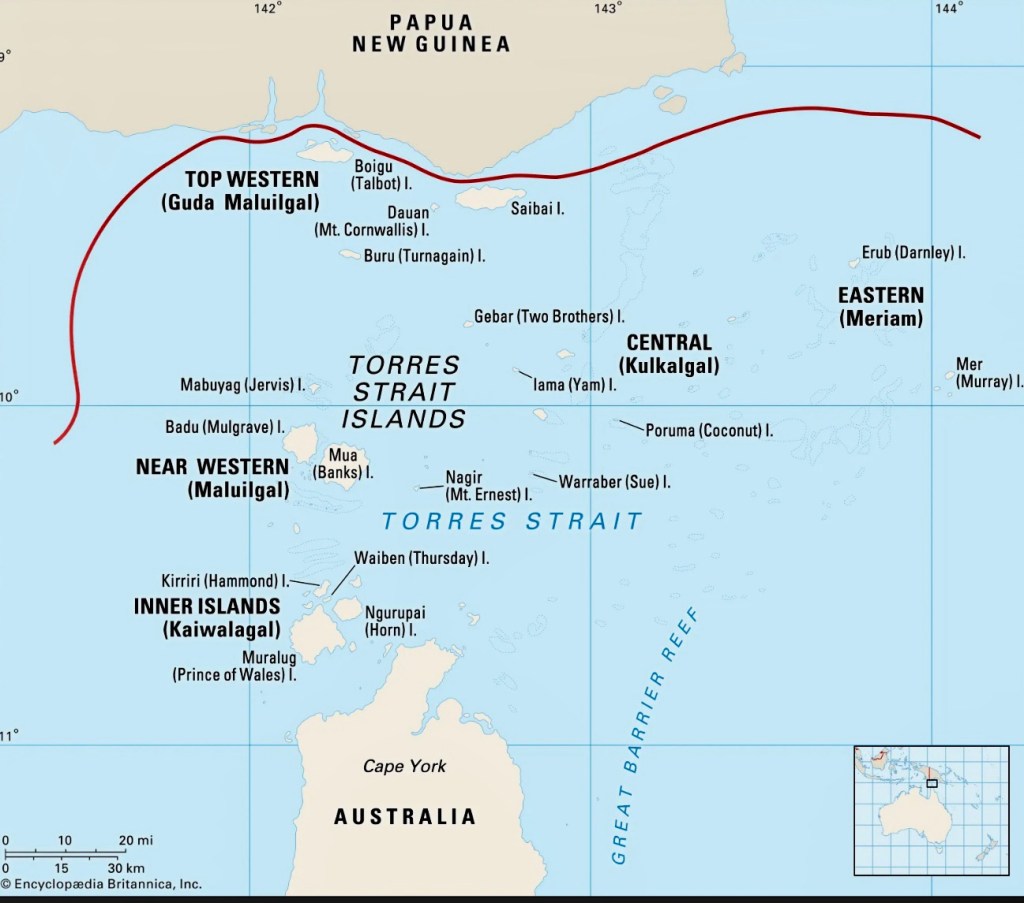
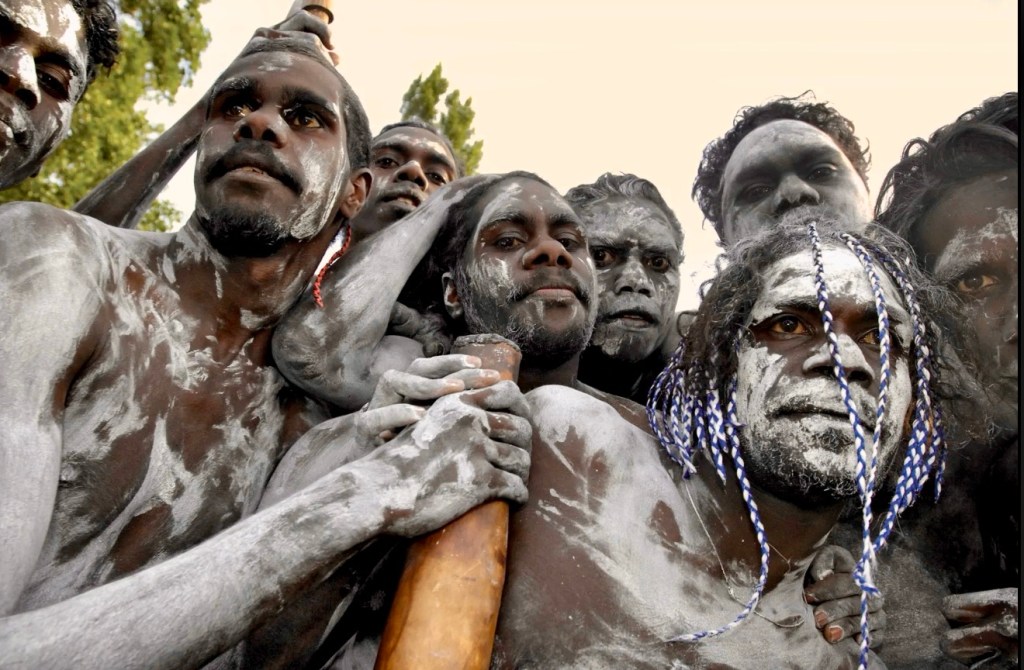
Torres Strait Islands, island group in the Torres Strait, north of Cape York Peninsula, Queensland, Australia, and south of the island of New Guinea. The group comprises dozens of islands scattered over some 18,500 square miles (48,000 square km) of water and organized into four geomorphological clusters: Top Western (low and alluvial, near New Guinea); Western (high, rocky, and barren, the largest being Prince of Wales Island); Central (coral); and Eastern (volcanic, with dense vegetation). Generally rich in offshore coral growth and marine fauna, the islands may be remnants of a land bridge that once linked Asia and Australia. They have been inhabited for at least 2,500 years. The present-day inhabitants are primarily of Melanesian origin, with some mixture of Polynesians and Southeast Asians. Culturally, the Torres Strait Islander peoples are typically divided into five groups: Top Western, Western, Lower Western, Central, and Eastern. The people of the Eastern Islands speak the Meriam Mir language, and those of the Western Islands and Central Islands speak Kala Lagaw Ya or Kala Kawa Ya, which are dialects of the same language.
Although the Spanish navigator Luis Vaez de Torres sailed through the islands in 1606, they did not become well known until the late 18th century, when fishermen came to hunt for mother-of-pearl shell and bêche-de-mer (sea cucumber). The islands were annexed by Queensland in 1879. At that time, the inhabitants were deprived of their landowning rights. They gained Australian citizenship in 1967.
In 1904, the peoples of the Torres Strait Islands were made subject to the Aboriginals Protection and Restriction of the Sale of Opium Act 1897, which gave draconian powers to the Queensland government in placing legal restrictions on natives and on their land use.
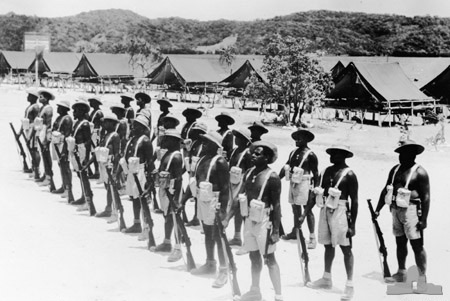
During World War II, many Torres Strait Islanders served in the Torres Strait Light Infantry Battalion of the Australian Army. It is the only Australian Army unit to have been formed out of indigenous Australians.
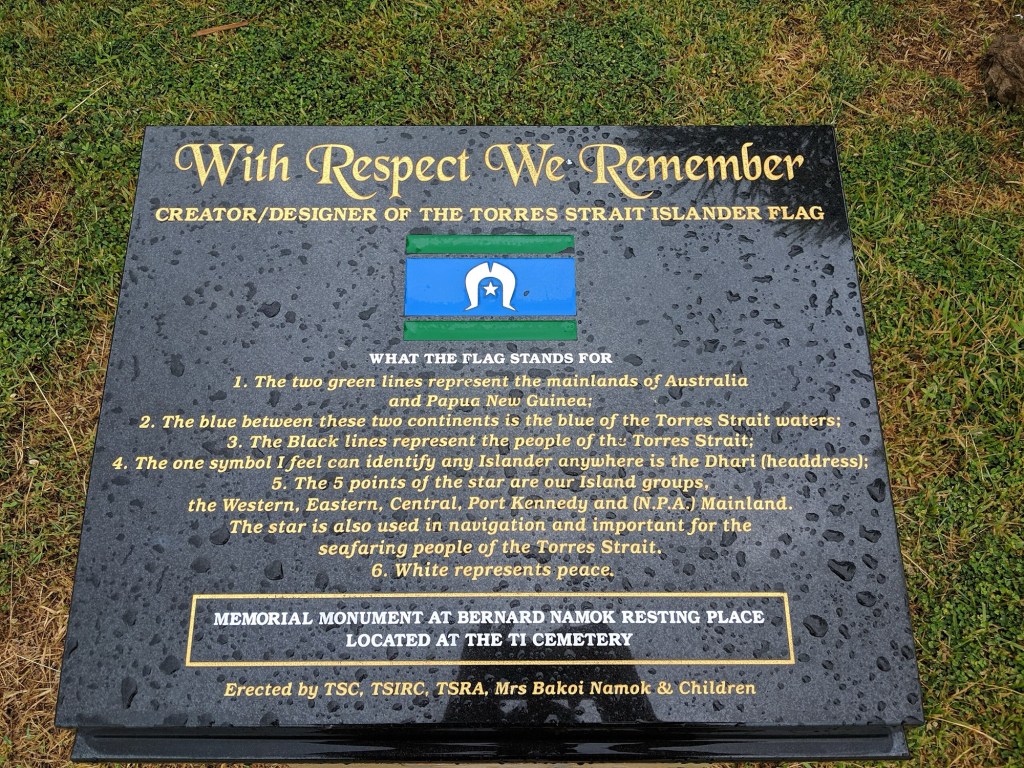
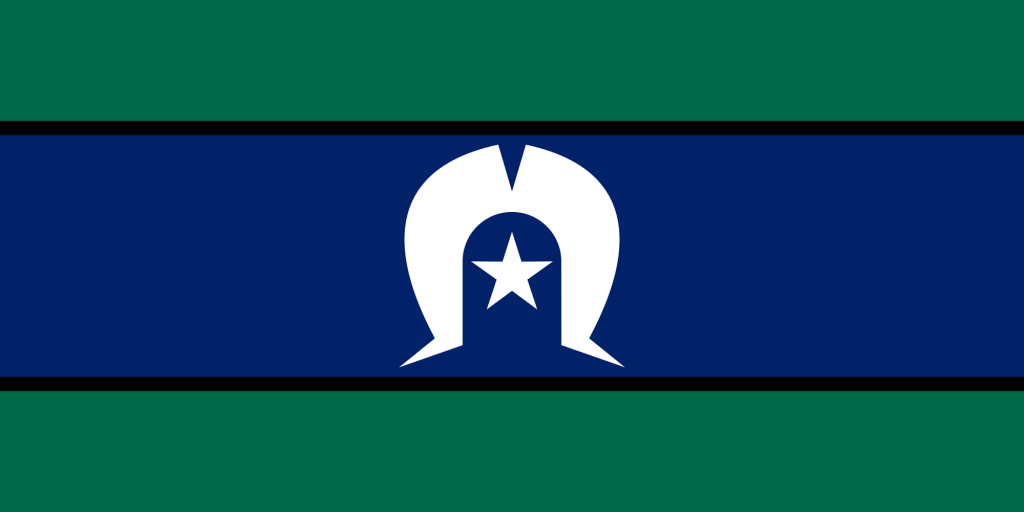
The Torres Strait Islander flag is the official flag of the Torres Strait Islanders, an Indigenous people of Australia. It was designed in 1992 by Bernard Namok, who won a local competition held by the Islands Coordinating Council. The flag was recognised by the Aboriginal and Torres Strait Islander Commission in June 1992. It was granted official status in 1995 under the Flags Act 1953, as was the Australian Aboriginal flag.
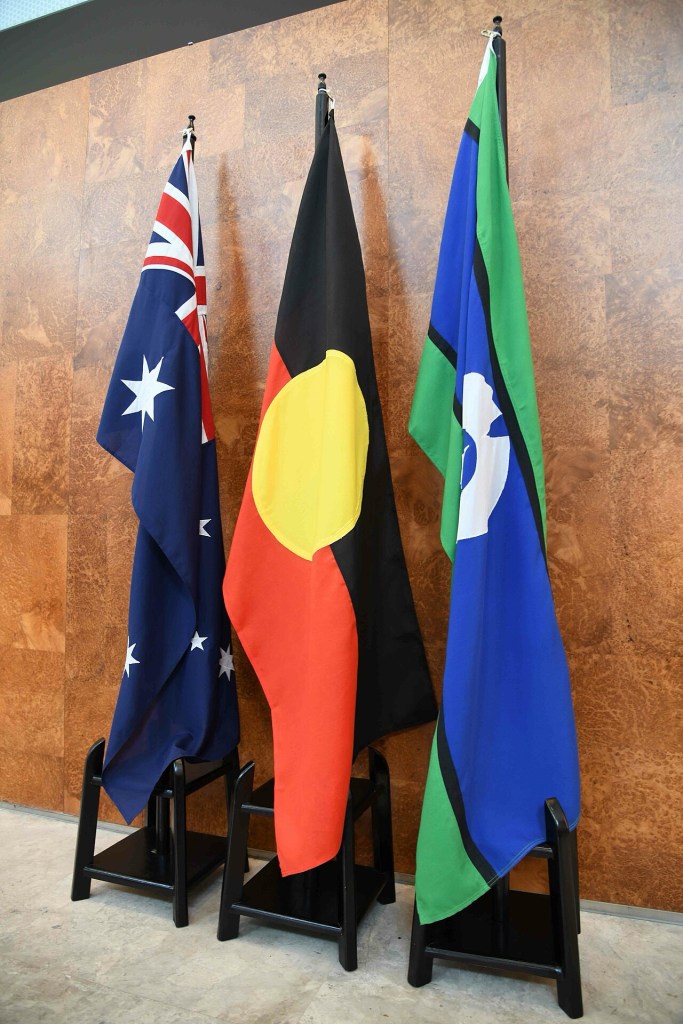
On 14 July 1995, Governor-General Bill Hayden issued a proclamation under section five of the Flags Act 1953 declaring the flag to be “recognised as the flag of the Torres Strait Islander people of Australia and a flag of significance to the Australian nation generally”. The flag was ‘disrespected’ as much as the people it represented. Through an ‘administrative over site’ the flag was in effect revoked and no longer recognized as representing the proud people of the Torres Straight Islands. Finally in 2008 the Australian government declared: “it is recognised as the flag of the Torres Strait Islander people of Australia and a flag of significance to the Australian nation generally”. It is appointed “to be the flag of the Torres Strait Islander people of Australia and to be known as the Torres Strait Islander Flag”.
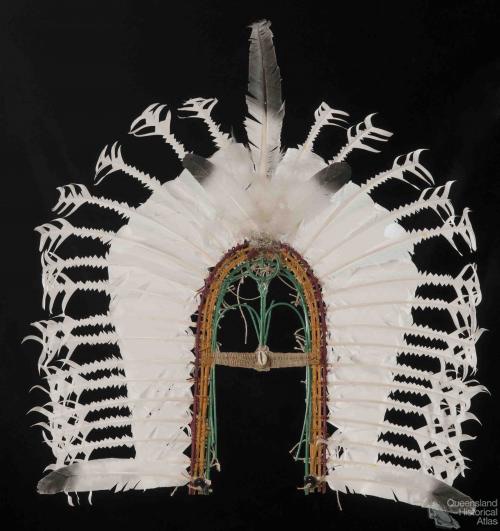
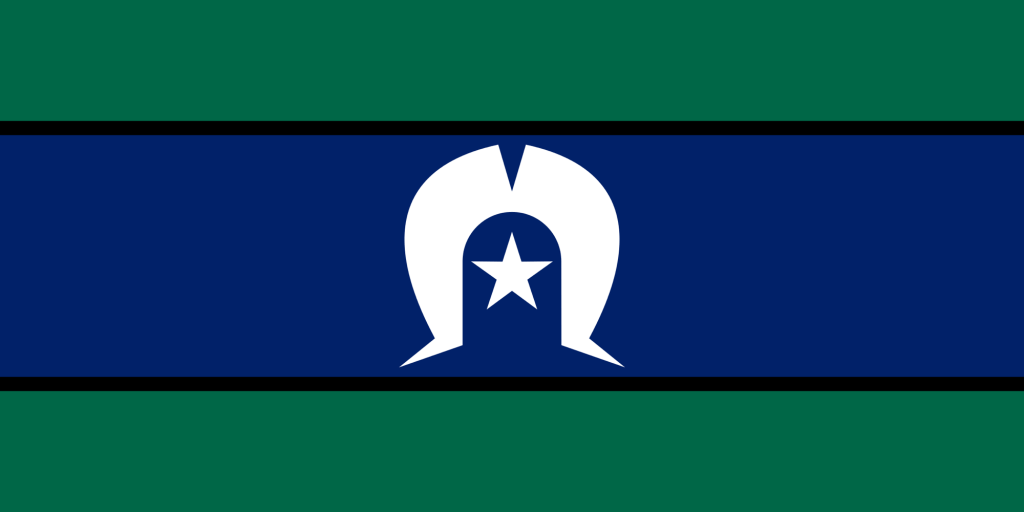
The green panels at the top and the bottom of the flag symbolise the land, while the blue panel in the centre represents the waters of the Torres Strait. The thin black stripes between the green and blue panels signify the Torres Strait Islanders themselves. The white five-pointed star at the centre of the flag represents the five major island groups—the Western, Eastern, Central, Port Kennedy and (N.P.A.) Mainland—and the white dhari (also spelt dari, a ceremonial dancer’s headdress around it also symbolises the Torres Strait Islands people. White symbolises peace, while the star is a symbol for navigation.
 deliriouslove1970. The life & times of Gary and Denise Flanders. (Free and worth every penny. If you would like to compliment the editor, send to garytheflan@deliriouslove1970.com. If you would like to complain, call your mother.)
Leave a comment