

“East Timor, island country in the eastern Lesser Sunda Islands, at the southern extreme of the Malay Archipelago. It occupies the eastern half of the island of Timor, the small nearby islands of Atauro (Kambing) and Jaco, and the enclave of Ambeno, including the town of Pante Makasar, on the northwestern coast of Timor. Dili is the capital and largest city.”

Most of the people are of Papuan, Malayan, and Polynesian origin and are predominantly Christian. About 40 different Papuan and Malayan languages or dialects are spoken, dominated by Tetum. Portuguese is spoken by a small fraction of the population, but it is one of the country’s two official languages, the other being Tetum; Indonesian and English are considered to be “working” languages.
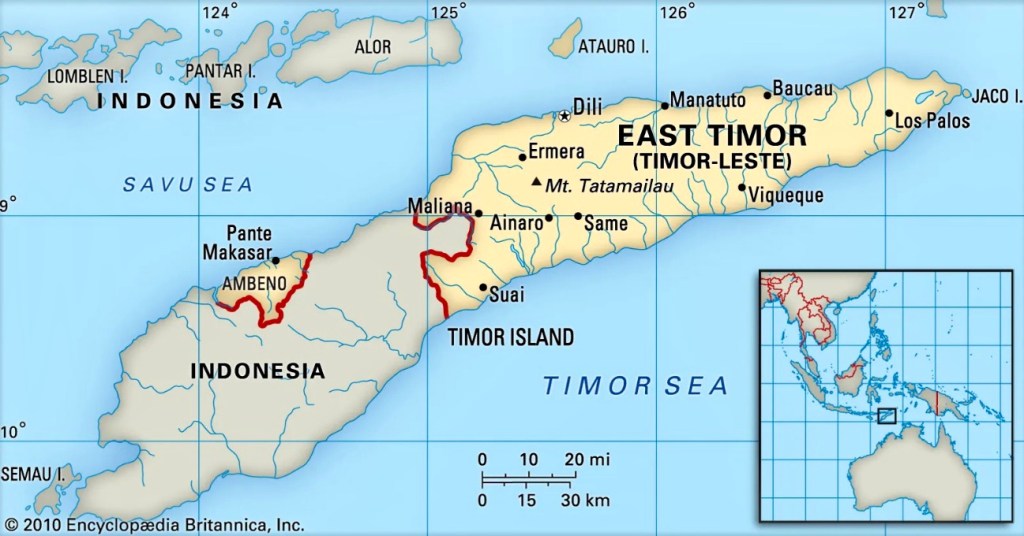
The Portuguese first settled on Timor in 1520, and the Spanish arrived in 1522. The Dutch took possession of the western portion of the island in 1613. The British governed the island in 1812–15. The Dutch and the Portuguese fought for supremacy over Timor, and Portuguese sovereignty over the island’s eastern half was settled by treaties in 1860 and 1893, although the latter became effective only in 1914. Japanese forces occupied Timor during World War II. East Timor province, including the Ambeno enclave, thereafter remained in Portuguese possession until 1975, when one of the major political parties there, Fretilin (Frente Revolucionária do Timor-Leste Independente [Revolutionary Front for an Independent East Timor]), gained control of much of the territory and in November declared its independence as the Democratic Republic of East Timor. Early in December Indonesianforces invaded and occupied the area, and in 1976 Indonesia declared it to be an integral part of that country as the province of East Timor (Timor Timur).
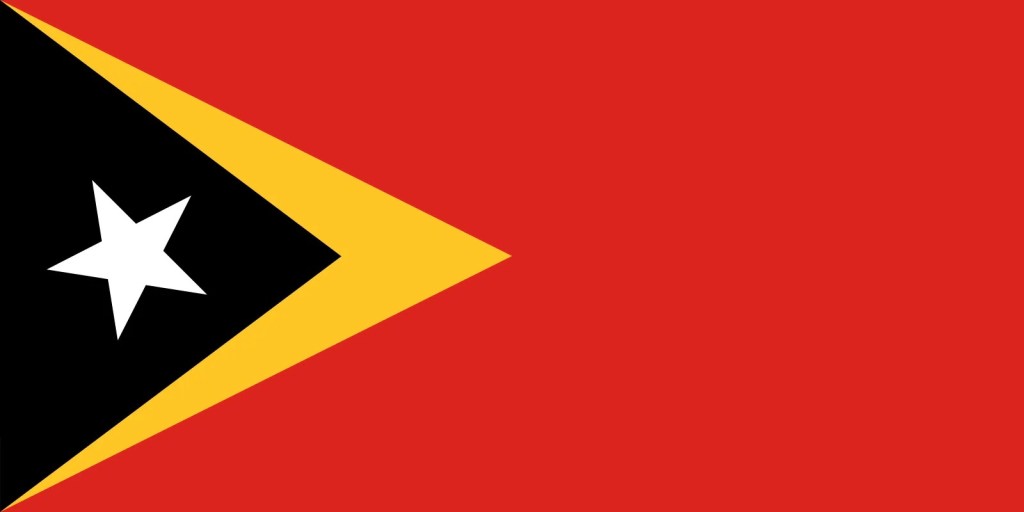
The flag is based on a design used by the Revolutionary Front of Independent East Timor (Fretilin), the main group opposing Indonesia’s takeover of East Timor in 1975–76. That flag consisted of a striped red-yellow-red field with a black canton along the hoist bearing a white star. Following Indonesia’s withdrawal in 1999, East Timor was administered by the UN, and the UN flag flew over it. The new national flag was adopted on May 20, 2002, when East Timor achieved full sovereignty. The black represents more than four centuries of colonial repression, the yellow the struggle for independence, and the red the suffering of the East Timorese people. The white star symbolizes hope for the future.
The national flag of East Timor(bandeira nacional de Timor-Leste) consists of a red field with the black isosceles triangle based on the hoist-side bearing a white five-pointed star in the center superimposed on the larger yellow triangle, also based on the hoist-side, that extends to the center of the flag.

- Black represents the four centuries of colonial oppression.
- The yellow arrowhead represents “the traces of colonialism in East Timor’s history” and the struggle for independence.
- Red stands for the spilled blood of the population.
- The white star symbolises hope for a better future.
 deliriouslove1970. The life & times of Gary and Denise Flanders. (Free and worth every penny. If you would like to compliment the editor, send to garytheflan@deliriouslove1970.com. If you would like to complain, call your mother.)
Leave a comment