

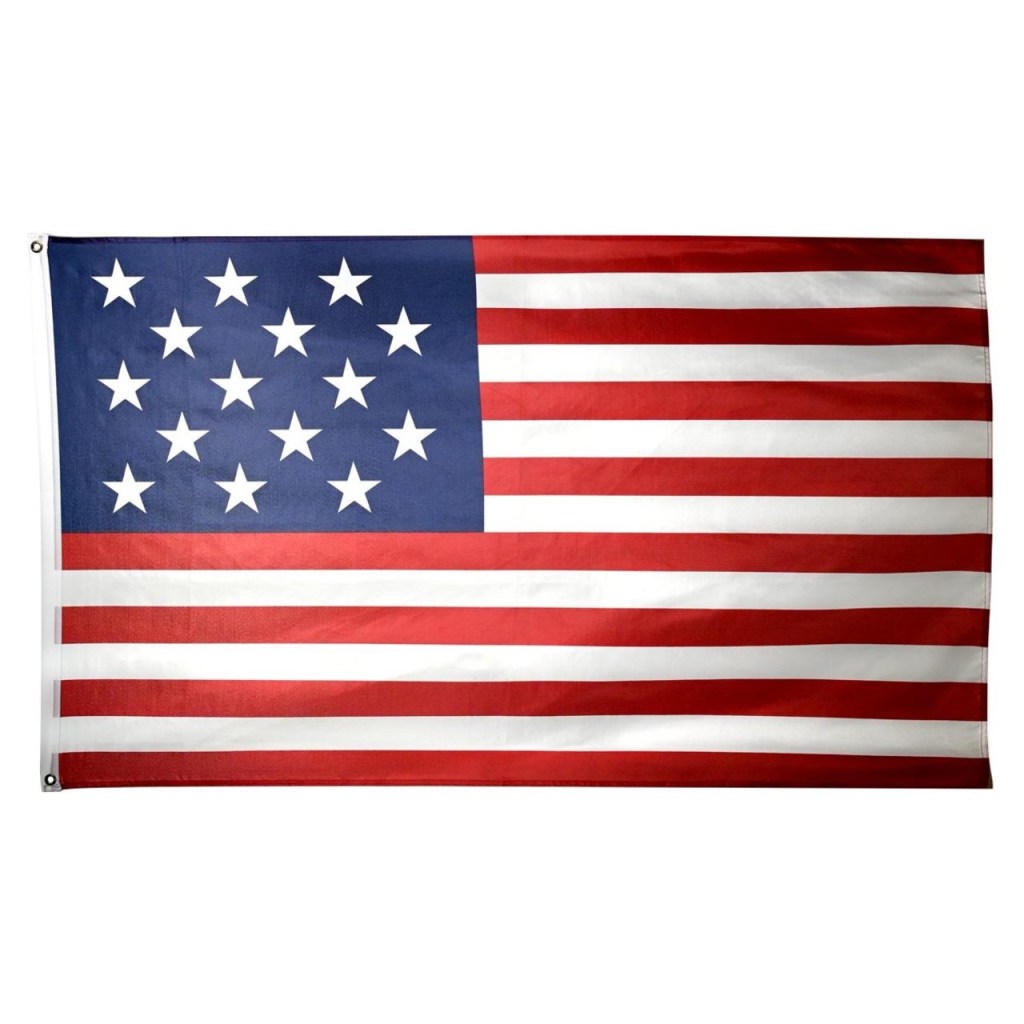
“The Star-Spangled Banner, or the Great Garrison Flag, was the garrison flag that flew over Fort McHenry in Baltimore Harbor during the naval portion of the Battle of Baltimore during the War of 1812. It is on exhibit at the National Museum of American History, Smithsonian Institution. Seeing the flag flying over Fort McHenry on the morning of September 14, 1814, after the battle ended, Francis Scott Key was inspired to write the poem “Defence of Fort M’Henry“. These words were written by Key and set to the tune of “To Anacreon in Heaven“, a popular song at the time, by John Stafford Smith. In 1931 the song became the national anthem of the United States.
More broadly, a garrison flag is a U.S. Army term for an extra-large national flag that is flown on Sundays, holidays, and special occasions. The U.S. Navy term is “holiday colors”.
With fifteen stripes, the Star-Spangled Banner remains the only official American flag to bear more than thirteen stripes.”
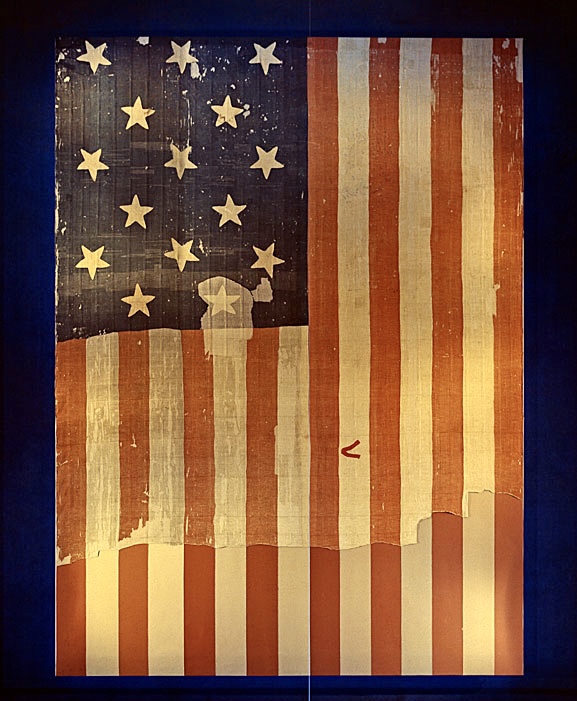
“The flag was stitched from a combination of cotton and dyed English wool bunting. It has fifteen horizontal red and white stripes, as well as fifteen white stars in the blue field. The two additional stars and stripes, approved by the United States Congress‘s Flag Act of 1794, represent Vermont and Kentucky‘s entrance into the Union. The stars are arranged in vertical rows, with five horizontal rows of stars, offset, each containing three stars. At the time, the practice of adding stripes (in addition to stars) with the induction of a new state had not yet been discontinued.
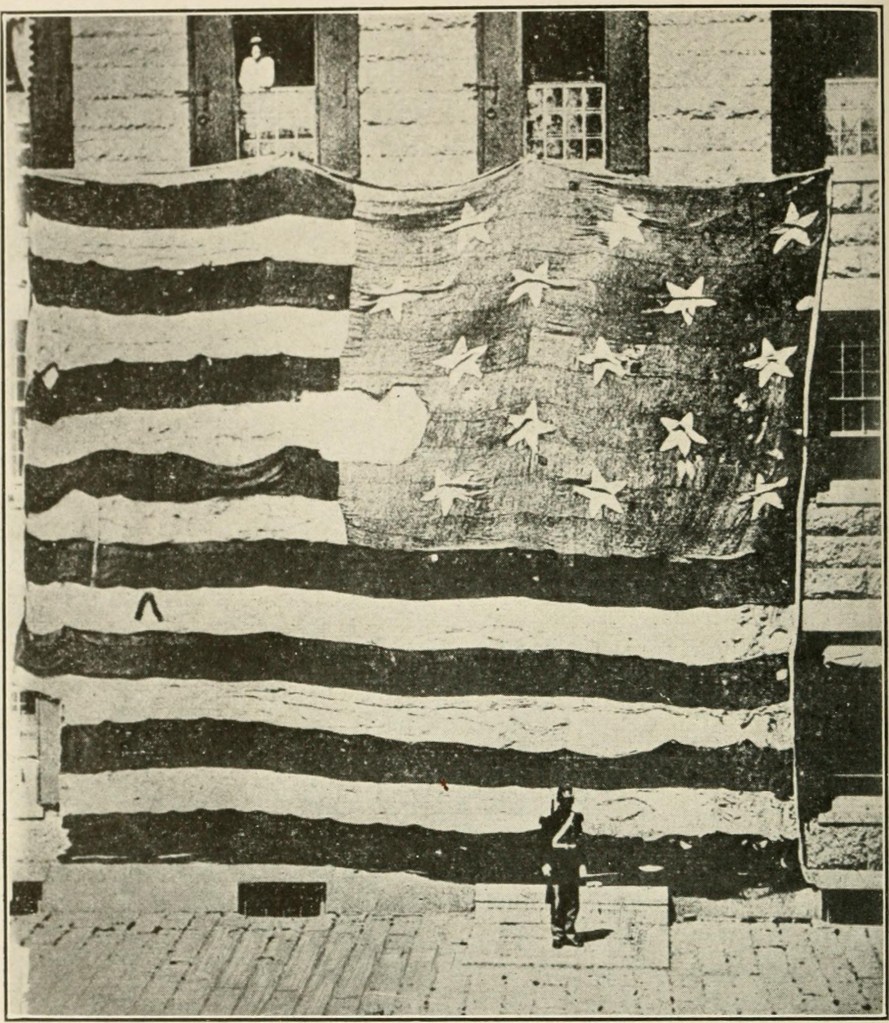
The flag originally measured 30 by 42 feet (9.1 by 12.8 m) and weighed about 50 pounds (23 kg). Each of the fifteen stripes is 2 feet (0.61 m) wide, and each of the stars measures about 2 feet (0.61 m) in diameter. Several feet of fabric have been lost from the flag’s fly end, from cuttings that were given away as souvenirs and gifts, as well as from deterioration from continued use.[6] It now measures 30 by 34 feet (9.1 by 10.4 m). The flag currently has only fourteen stars—the fifteenth star was similarly given as a gift, but its recipient and current whereabouts are unknown.”
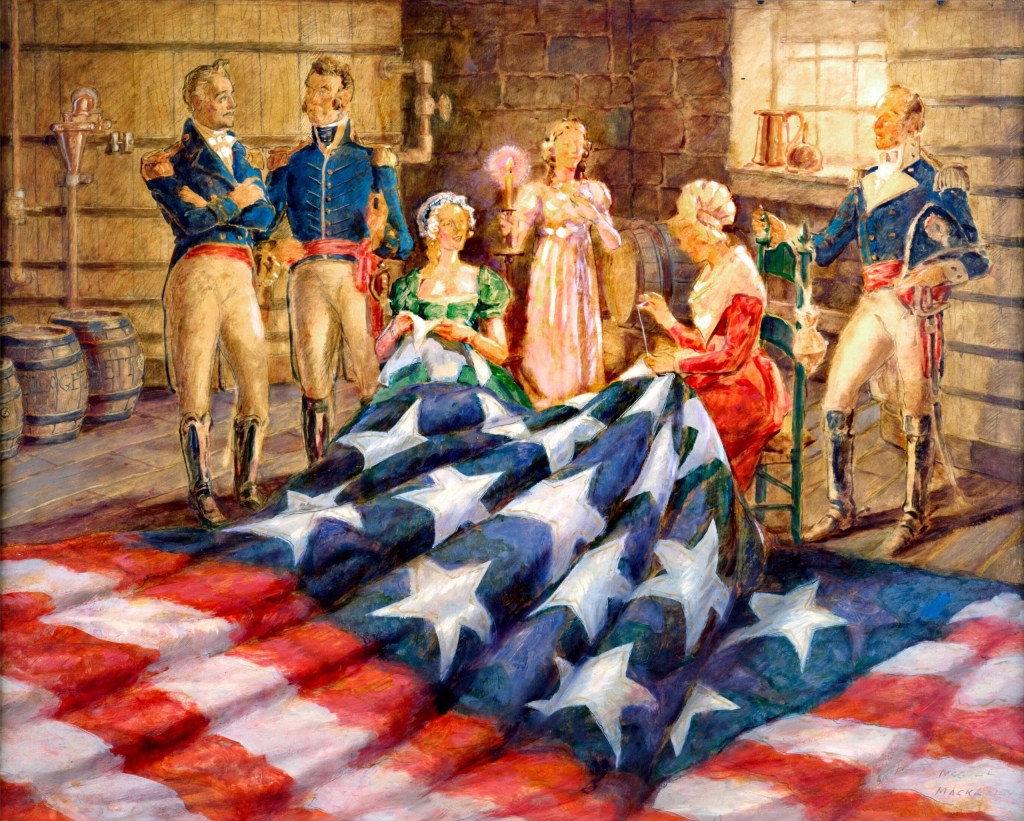
The flag was sewn by prominent Baltimorean flagmaker Mary Young Pickersgill under a government commission in 1813 at a cost of $405.90 (equivalent to $6,154 in 2022). Armistead specified “a flag so large that the British would have no difficulty seeing it from a distance”.
Pickersgill made the flag with assistance from her daughter, two nieces, and an African American indentured servant, Grace Wisher.”
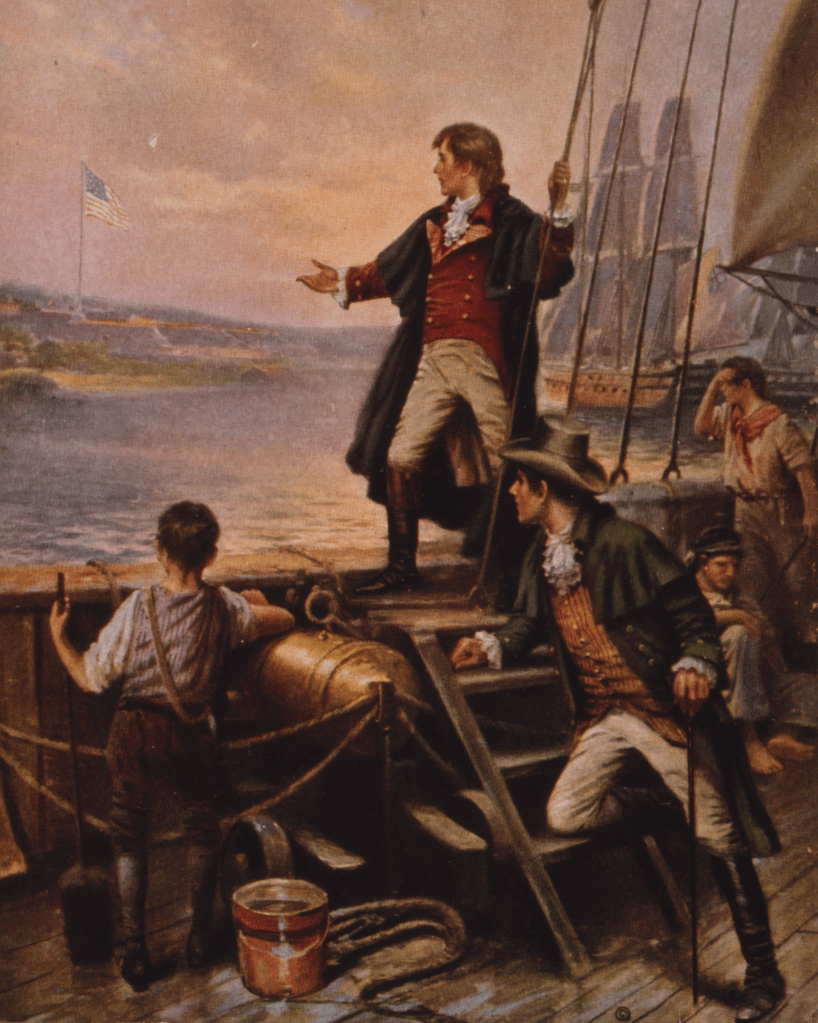
“On September 12, 1814, 5,000 British soldiers and a fleet of 19 ships attacked Baltimore. The bombardment turned to Fort McHenry on the morning of September 13, and continuous shelling occurred for 25 hours under heavy rain. When the British ships were unable to pass the fort and penetrate the harbor, the attack was ended.
There is conflicting evidence as to which flag, the larger garrison flag or the smaller storm flag, flew over the fort during the battle. Historians suggest that the storm flag flew through the night, and the garrison flag was hoisted in the morning, after the British retreated.
On the morning of September 14, when the flag was seen flying above the ramparts, it was clear that Fort McHenry remained in American hands. This revelation was famously captured in poetry by Francis Scott Key, an American lawyer and amateur poet. Being held by the British on a truce ship in the Patapsco River, Key observed the battle from afar. When he saw the garrison flag flying in the morning, he composed a poem he originally titled “Defence of Fort McHenry”. The poem would be put to the music of a common tune, retitled “The Star-Spangled Banner“, and a portion of it would later be adopted as the national anthem of the United States.”
 deliriouslove1970. The life & times of Gary and Denise Flanders. (Free and worth every penny. If you would like to compliment the editor, send to garytheflan@deliriouslove1970.com. If you would like to complain, call your mother.)
Leave a comment